






Vacuum evaporated perovskite solar cells with a power conversion efficiency of 15% have been characterized using hyperspectral luminescence imaging. Hyperspectral luminescence imaging is a novel technique that offers spectrally resolved photoluminescence and electroluminescence maps (spatial resolution is 2 micrometer) on an absolute scale. This allows, using the generalized Planck’s law, the construction of absolute maps of the depth-averaged quasi-Fermi level splitting (Dl), which determines the maximum achievable open circuit voltage (Voc) of the solar cells. In a similar way, using the generalized reciprocity relations the charge transfer efficiency of the cells can be obtained from the hyperspectral images. Very strong inhomogeneity, both in quasi-Fermi level splitting (Dl) and in charge transfer efficiency, are found in these vacuum deposited perovskite solar cells. This implies that these efficient solar cells are still far from perfect as many areas in the device do not or only partially participate in the photon to electron conversion processes.
Scientific Papers
Quantification of Spatial Inhomogeneity in Perovskite Solar Cells by Hyperspectral Luminescence Imaging
Year
2016
Related products
Summary
Gilbert El-Hajje, Cristina Momblona, Lidon Gil-Escrig, Jorge Avila, Thomas Guillemot, Jean-François Guillemoles, Michele Sessolo, Henk J. Bolink, and Laurent Lombez
Related products
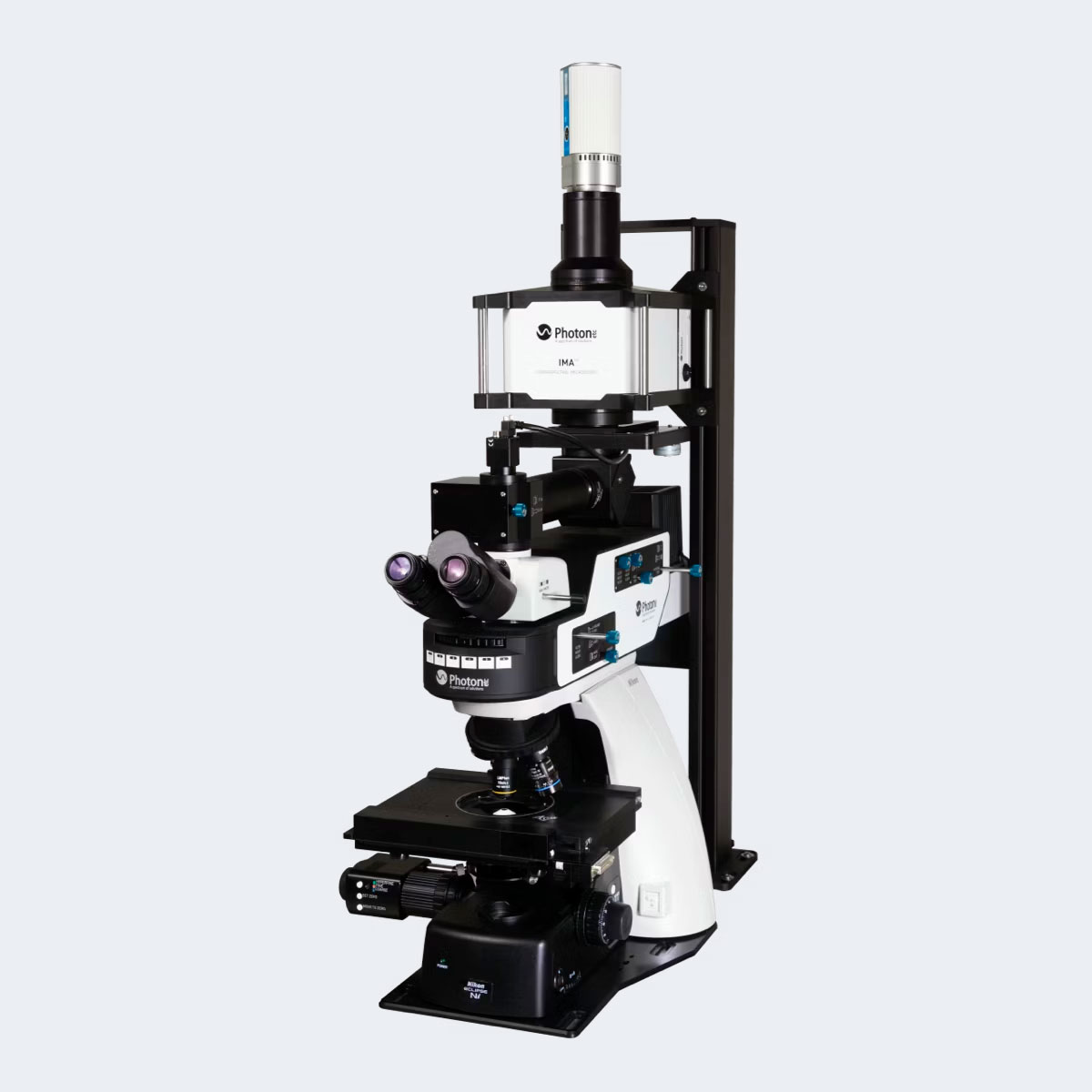
IMA™
IMA is a hyperspectral microscope delivering spectral and spatial information from 400 nm to 1620...