ACS Applied Materials & Interfaces
- Pérovskite
Defect Suppression and Efficiency Enhancement of Slot-Die-Coated Formamidinium Lead Iodide Solar Devices via Ambient Air Annealing
Auteurs K. M. Muhammed Salim, Iwan Zimmermann, Nao Harada, Celia Aider, Thomas Guillemot, Mirella Al Katrib, Juan Pablo Medina Flechas, Pilar Lopez-Varo, Mattia Da Lisca, Jose Alvarez, Alexandra Levtchenko, Van-Son Nguyen, Karim Medjoubi, Dounya Barrit, Daniel Ory, Stefania Cacovich, Jean-Paul Kleider, Muriel Bouttemy, Jean Rousset
Résumé
Scalable manufacturing of perovskite photovoltaics requires deposition routes that deliver phase-pure, defect-free films with high uniformity over large areas. Here, we demonstrate the scalable fabrication of smooth, conformal, and ribbing-free formamidinium lead iodide (FAPI) perovskite thin films via a slot-die coating process. The ambient air annealing treatment effectively suppresses nonradiative recombination pathways, as confirmed by comprehensive photophysical and electrical characterizations. This facile treatment enhances charge carrier separation, reduces interfacial recombination, and improves the open-circuit voltage, leading to superior device performance. The optimized and nonpassivated FAPI solar cells deliver a champion power conversion efficiency (PCE) of 20.8% in small-area device. Furthermore, series-connected minimodules achieve PCEs of 19.1% and 14.8% for active areas of 8.4 cm2 and 59.5 cm2, respectively. The slot-die coated FAPI devices exhibit excellent operational stability, retaining over 80% of their initial efficiency after 450 h of continuous illumination under maximum power-point tracking. In addition, we evaluate the stability of unencapsulated FAPI minimodules under dark storage, revealing spatial variation in QFLS, bandgap, and voltage losses. These findings highlight the potential of slot-die coating as a scalable and industry-compatible route for producing stable, high-performance FAPI perovskite solar modules.
Produits associés
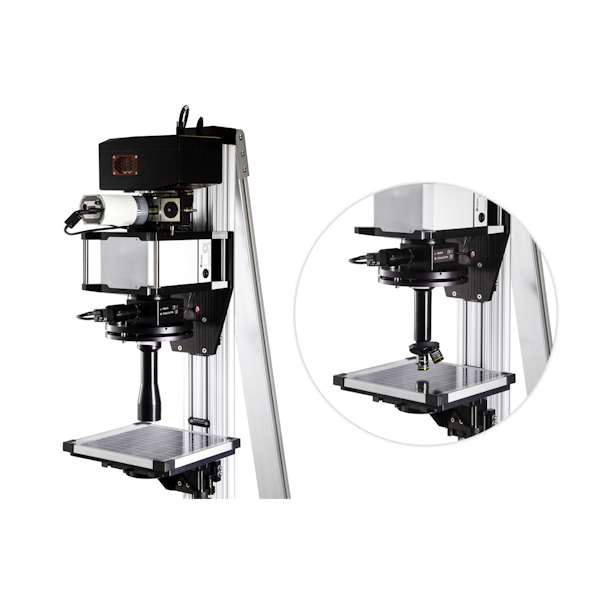
GRAND-EOS™
GRAND-EOS est une caméra hyperspectrale accordable sur la plage spectrale de 400-1650 nm. Ce système combine des modalités d’imagerie micro et macro.